 Midnight Outpost
· Midnight Outpost Team · Devlog · 3 min read
Devlog #7 — The Lake Zone
A shimmering body of water now sits at the edge of the known world. The Lake Zone brings animated water tiles, a handcrafted shoreline, and the first fishing item — even if the fish aren't biting yet.
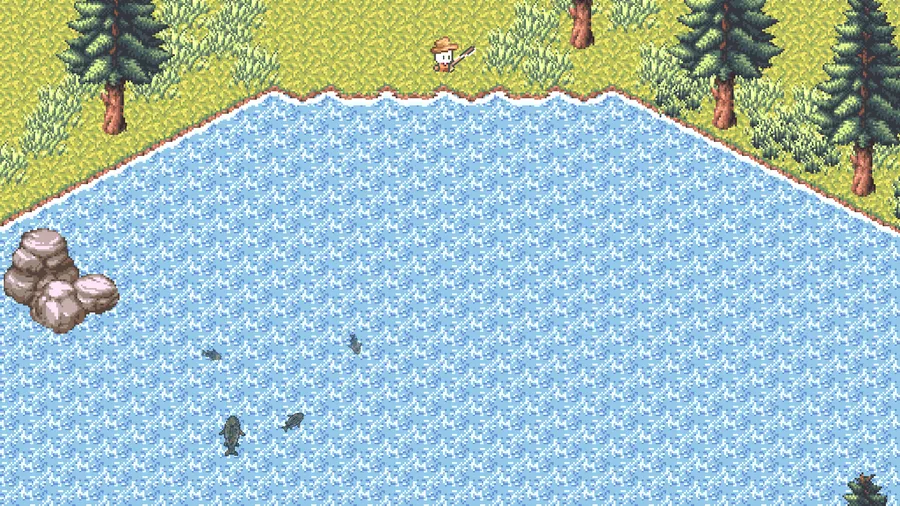
The Forest gave you wood. The Mine gave you stone. Now the world gives you somewhere to breathe. The Lake Zone is live — a calm, shimmering body of water placed further out in the world, surrounded by pine trees and rocky shores.
Filling Out the World
The world of Midnight Outpost is organized in concentric rings around the outpost. The Forest and Mine sit close, in the first ring — reachable early and essential for survival. The Lake lives further out, in Ring 2, requiring a longer venture before you reach it.
Its position is derived from the world seed, so it’s always in a different direction, always at the right distance, and never overlapping with the other zones. The world has a shape — it’s not just scattered content.
A Handcrafted Shoreline, Placed by the World
The lake itself is hand-built — every tile of the shoreline, every rocky outcrop, every cove is placed deliberately. It’s not procedurally generated; it’s designed to look and feel like a real lake, with an organic outline that no algorithm would reliably produce.
What’s procedural is its placement in the world. The seed determines where in the ring the lake appears — its direction from the outpost, its exact coordinates. The lake always looks the same; the world decides where it lives.
The terrain around it follows naturally: grass and ground tiles give way to a dirt shore, which gives way to water. The transition feels grounded, like an actual body of water carved into the landscape.
Animated Water
The water tiles are not static. The lake uses a programmatically generated animated tileset — the animation frames are wired up at load time rather than authored by hand. The tiles shimmer and shift in a subtle loop, giving the surface life without being distracting.
The shore edge follows the same jagged organic outline as the CA-generated coastline, so the animated water never bleeds past the land.
The Fishing Rod
Alongside the Lake Zone, a Wooden Fishing Rod has been added to the game as an equippable tool. It has its own item category, its own hand animation — and for now, that’s about it. The mechanics to actually fish are coming later: casting a line, waiting for a bite, reeling it in.
The infrastructure is in place. The lake is there. When the time comes, it’ll all connect.
Zone Loading
Like the Forest and Mine, the Lake Zone loads and unloads dynamically as you move through the world. It has its own manager, its own seed-based position, and nothing loads until you’re close enough to need it.
What’s Next
The Lake is in place — but it’s not alone for long. Next up is the Plains Zone, a wide open area near the lake well-suited for farming. The plan is to let players build crop fields there, grow food, and establish a supply of their own rather than relying entirely on what the world drops. Agriculture as a system, rooted in a specific place.